
For Wives Who Feel Lonely, Unseen, And Tired Of Carrying The Relationship
Emotionally Unavailable Husband: What To Do When You Feel Alone In Your Marriage
You can share a home, a bed, kids, bills, and an entire life with a man and still feel completely alone.
If your husband shuts down, gets defensive, tries to fix everything, or seems emotionally absent when you need him most, the problem is not simply that you need to “communicate better.”
You Desire Connection
You want to feel like he is with you. You want curiosity instead of defensiveness, presence instead of fixing, affection you do not have to request, and initiative you do not have to manage.
And after years of asking, explaining, reminding, and starting the hard conversations, you may be wondering whether it would actually feel less lonely to be alone.
Why Do I Feel So Alone In My Marriage?
Marital loneliness often becomes painful because your husband is close enough to remind you of the connection you are missing.
You may not be asking for hours of deep conversation. You may simply want him to notice when something is wrong, ask a second question, put down his phone, reach for you without being prompted, or care about something because it matters to you.
You may feel emotionally alone when:
- You handle difficult emotions by yourself because talking to him feels pointless.
- Most conversations are about kids, schedules, bills, work, or chores.
- You have to initiate affection, dates, sex, or meaningful conversations.
- He becomes defensive when you explain how his behavior affects you.
- He tries to prove why your feelings do not make logical sense.
- You feel more understood by friends than by your husband.
You may be carrying the relationship when:
- You track the emotional temperature of the marriage.
- You are always the one saying, “We need to talk.”
- You find the books, podcasts, counselors, or date ideas.
- You remind him what needs attention and then remind him again.
- You smooth over conflict so the family can function.
- You worry that if you stop trying, nothing will happen.
What Wives Of Emotionally Unavailable Husbands Actually Say
When women describe this problem in real marriage discussions, the language is strikingly consistent. They do not usually complain that their husband lacks the perfect communication technique. They describe loneliness, exhaustion, invisibility, and the feeling that they are responsible for keeping the relationship alive.
“I feel like I’m responsible for keeping the relationship going.”
Starting conversations. Smoothing things over. Managing the emotional tone. Trying to create connection.
Paraphrased from recurring themes in public marriage discussions.“Yes, he works. Yes, he pays bills. But there’s more to marriage than that.”
Providing matters. So does participating emotionally in the life you built together.
Paraphrased from recurring themes in public marriage discussions.“I don’t want to have to tell another adult what needs to be done.”
The exhaustion is not always the task itself. It is noticing, remembering, planning, asking, and following up.
Paraphrased from recurring themes in public marriage discussions.“I feel more lonely when he’s around.”
That sentence captures the strange pain of emotional disconnection: his physical presence can make the absence of emotional connection hurt even more.
Paraphrased from recurring themes in public marriage discussions.Why Is My Husband Emotionally Unavailable?
There is no single cause. Some men learned early that emotion was weakness. Some never learned how to name what they feel. Some withdraw when they feel criticized or inadequate. Others hide behind work, logic, screens, humor, sex, problem-solving, or silence because emotional discomfort makes them feel powerless.
And sometimes a husband who looks detached is not actually feeling nothing.
He may be feeling too much and have no confidence in his ability to stay present with it, so he chooses to numb out.
When his wife says, “I feel alone,” he may hear, “You’re failing as a husband.” He becomes defensive. She feels even less understood. She pushes harder to be heard. He shuts down harder to escape the feeling of failure.
She is trying to get closer. He experiences the conversation as proof that he is failing. The harder she reaches, the more he retreats.
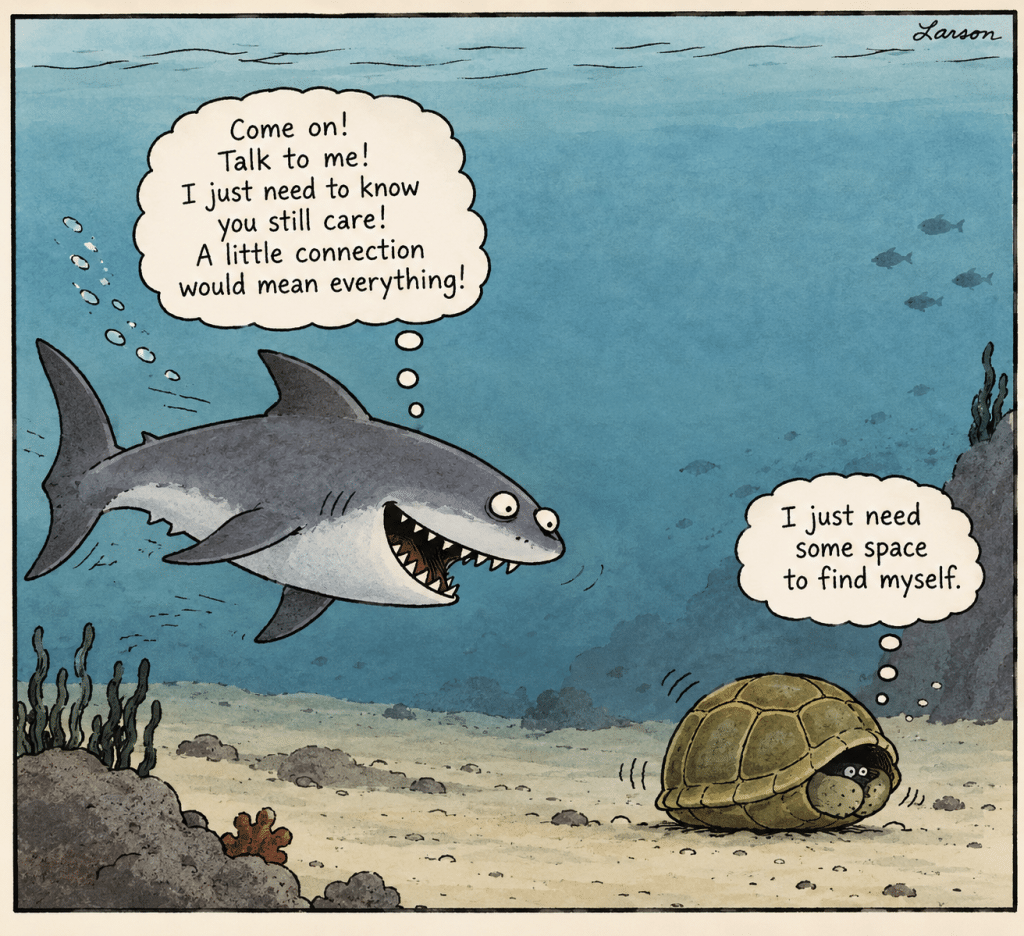
Sometimes the husband fears that the more he opens, the more those things could be weaponized against him.
He learned as a young boy that if he keeps to himself, there is less drama.
That got him through school, but it’s failing him in his marriage.
What Usually Does Not Work With An Emotionally Unavailable Husband
Trying Harder To Pull Him Out
More questions, longer talks, repeated reminders, and demanding that he open up can turn connection into another performance he thinks he is failing.
Explaining Your Pain For The 47th Time
If you have clearly explained the same need again and again, another three-hour explanation may only leave you feeling more rejected.
Managing Him Into Being A Better Husband
If you must assign every act of affection, schedule every date, and supervise every attempt at connection, you become his therapist instead of his partner.
Calling Him Heartless
Shame may get a reaction, but it rarely creates the curiosity, courage, or emotional presence you actually want.
What To Do When Your Husband Is Emotionally Unavailable
You cannot force emotional availability out of another adult. You can become clearer about what you need, stop carrying responsibilities that belong to him, and pay attention to whether he is willing to participate in creating a better marriage.
Get Specific About What “Connection” Means
Instead of “I need you to be more emotional,” identify the experience you miss: affection, curiosity, conversation, initiative, empathy, sex, shared time, teamwork, or feeling prioritized.
Talk About Your Experience, Not His Character
“I feel alone when I bring you something important and the conversation ends after one sentence” is clearer than “You’re emotionally unavailable and you don’t care.”
Stop Overfunctioning For The Marriage
You do not have to punish him or become cold. But notice what you are doing solely because you fear nothing will happen unless you do it. Give him room to take ownership. Things might get worse before they get better. If you stop mowing the lawn to create a gap for him to fill, the grass might get fairly tall before he sees the need and steps in. Trust that men rarely find the initiative to step in when someone else already has.
Ask For Participation, Not Mind Reading
A healthy husband does not need to guess every need. But once a need is clear, you should not have to spend years dragging him toward it.
Watch What He Does With The Information
Does he become curious? Does he take responsibility? Does he practice something different without needing constant supervision? Change is demonstrated through patterns, not promises made during one emotional conversation.
The Dangerous Stage: When A Lonely Wife Stops Trying
Many husbands assume things are improving when the arguments finally stop.
That’s usually not what’s happening.
Most women stop pushing for a better relationship when they no longer care about the relationship.
- She stops asking him to spend time with her.
- She stops initiating hard conversations.
- She stops complaining about affection or sex.
- She starts building more of her emotional life outside the marriage.
- She seems strangely calm about problems that used to upset her.
Silence is not always peace. Sometimes it is resignation.
If you are the husband reading this and your wife has recently “stopped nagging,” do not automatically assume the problem solved itself.
If you are the wife reading this, search your heart and notice your intentions.
Hanging onto resentment only hurts the person holding onto it.
A mature approach is: “God, grant me the serenity to accept the things I cannot change, the courage to change the things I can, and the wisdom to know the difference”.
If Your Wife Sent You This Page
She probably is not asking you to become more emotional than she is.
She is asking you to become more present.
I can teach you how to do that where it feels STRONG, CLEAR, and not like another chore.
She wants to know that when life gets uncomfortable, you will not disappear into work, your phone, silence, defensiveness, or a list of solutions (ask me how I know about trying to avoid her moods).
She wants to feel that you can hear something difficult without collapsing into shame or turning the conversation into a trial about whether you are a good husband.
The more self-confidence you have, the less you will slip into those things.
Your job is not to have the perfect response. Your job is to become a man who can stay in the room with love when emotions are on the table because your spine is strong and your front is soft.
Start Here
- Put down the phone and give her your full attention.
- Ask one more curious question before offering a solution.
- Let her feelings exist without correcting the facts.
- Take initiative without waiting to be assigned a job.
- Notice what needs attention in your marriage and act on it.
- Learn to tolerate the discomfort of emotions by not needing others to validate who you are.

A Note From Garrett
I work with men who can make difficult decisions at work, lead teams, solve problems, and provide for their families, yet feel completely lost when their wife says, “You don’t understand me.”
The answer is not becoming passive, apologizing for everything, or memorizing the perfect communication script.
It is developing enough emotional confidence that you can hear your wife’s experience without getting defensive, fixated on the outcome, or desperate to prove your intentions.
That is where emotional availability starts.
Frequently Asked Questions About Emotionally Unavailable Husbands
What are the signs of an emotionally unavailable husband?
Common signs include shutting down during emotional conversations, becoming defensive when you describe your experience, avoiding vulnerability, offering solutions instead of empathy, rarely initiating affection or deeper conversation, and leaving you feeling that you must manage the emotional connection in the marriage.
Why do I feel lonely even though I am married?
You can feel lonely in marriage when physical proximity is not matched by emotional connection. Add fear, shame, and trying to perform, and you can feel lonely even when in a room full of people. If you do not feel seen, heard, understood, wanted, or emotionally accompanied by your spouse, sharing a house can still feel profoundly lonely.
Can an emotionally unavailable husband change?
Yes, emotional patterns can change when a husband recognizes his part in the disconnection and consistently practices greater presence, curiosity, responsibility, and vulnerability. His willingness to change matters more than promises made during a crisis. The deeper work is for him is to develop unshakable self-confidence so he can allow his love to penetrate his relationship instead of his reactions.
How do I get my emotionally unavailable husband to open up?
You cannot force him to open up. You can create clearer invitations to connect, speak about your experience without attacking his character, and stop doing his emotional work for him. He ultimately has to choose to participate. Never underestimate your feminine power of receptivity. It’s like a drug to men that draws him out. The receptive woman doesn’t push; she allows her softness to pull people closer to her.
Does emotional unavailability mean my husband does not love me?
Not necessarily. A man can love his wife and still lack the skills, confidence, awareness, or willingness needed for emotional intimacy. Love and emotional availability are related, but they are not the same thing. Many men love their wife dearly, but the ways he shows it are the ways he wants to receive it, not the ways she feels it.
What if I am tired of being the only one trying?
Take that exhaustion seriously. Get clear about what you need, what you are willing to contribute, and what responsibilities you have been carrying for him. A marriage cannot become mutually connected if one spouse must continually manage the other person’s participation. A mature partner focuses on what’s in their control, not what’s outside their control. Your responses are always within your control.
The Bottom Line
If your husband is emotionally unavailable, the goal is not to find the magical words that finally make him understand you.
Criticism, contempt, blaming, and victimhood only lead to an immature relationship.
The goal is to stop confusing more effort from you with more connection between you.
You can clearly express what you need. You can stop attacking, chasing, fixing, and managing.
You can create room for a healthier pattern.
Then he has an important choice to make:
Will he step into the marriage as an emotionally present partner, or continue waiting for you to carry the connection for both of you?
When you show up consistently as the woman you’re proud of, over time, it becomes obvious if the relationship is growing to meet that standard or not.
The most powerful way to draw a man out is through feminine behaviours.
Never underestimate your superpowers as a woman who is in touch with her femininity.